Sodium-ion vs lead-acid

A lighter direction.
A wider perspective.

Sodium-ion offers a new combination for motorcycle starting: useful energy with less weight, high-power development opportunities and a different material foundation. Compare these opportunities with the complete battery and the motorcycle’s actual starting duty.

Technology-level comparison · Not a matched test of two specific models.

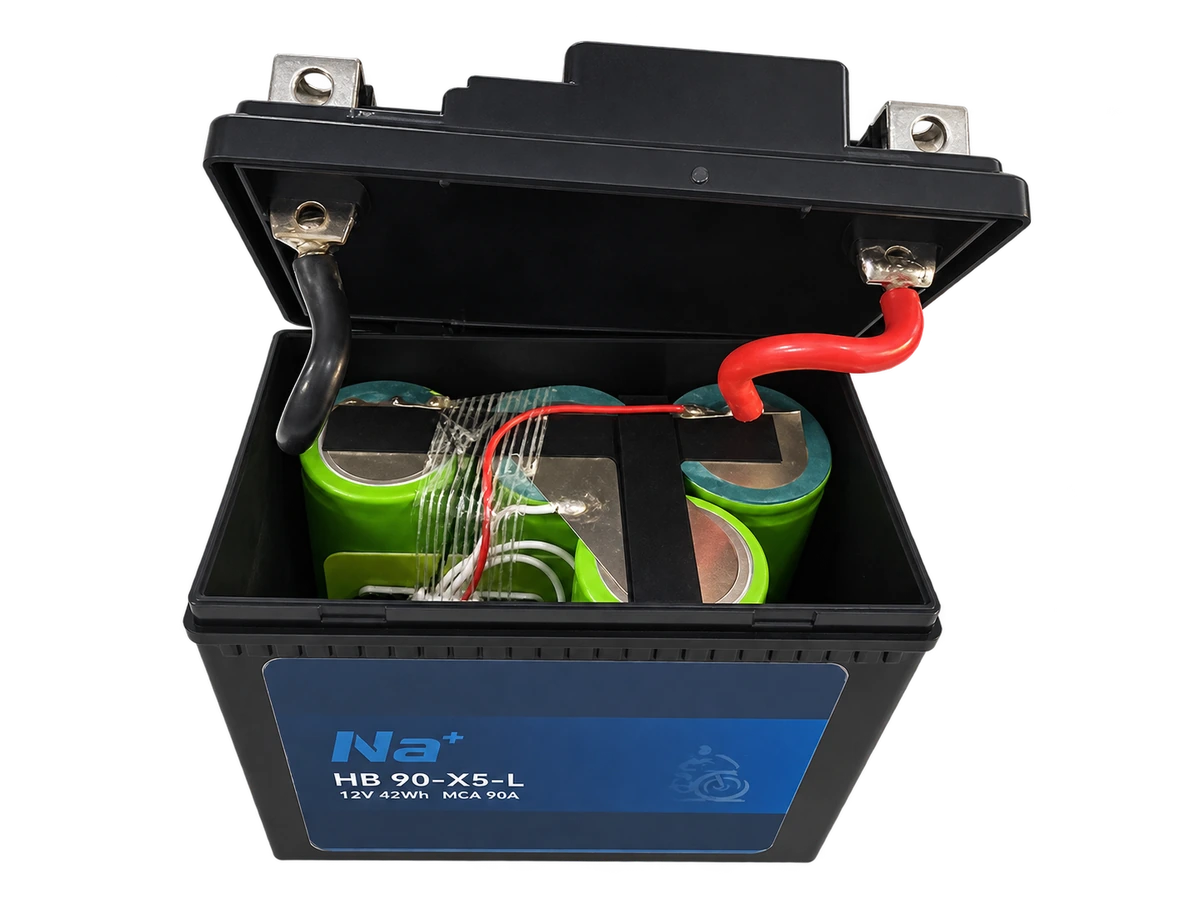
Illustrative opened sodium-ion starter battery with cylindrical cells visible
Opened sample · AI-cleaned illustration · Construction varies by configuration

The opportunity

Why sodium-ion
belongs in the conversation.

01

A lighter starting proposition

For distributors, weight is an easy benefit to explain and demonstrate. The technology-level energy-density advantage gives sodium-ion a meaningful route to a lighter battery. Present it with the measured mass of the supplied pack and the intended starting requirement, so customers can understand the practical benefit without relying on a generic percentage.

[1] Sources

02

High-current design potential

Starting asks for a brief burst of power rather than a long, gentle discharge. Independent sodium-ion pack research has demonstrated repeated engine starts and high-current pulses. This makes power-focused sodium-ion designs relevant to a starter-battery upgrade, with the finished pack evaluated at the required temperature and voltage under load.

[2] Sources

03

A different material foundation

Sodium-ion adds another chemistry to the battery industry’s material and supply-chain choices. Its widely available sodium resource base is one reason the technology is attracting research and manufacturing investment. That long-term opportunity belongs alongside the practical benefits of a lighter finished battery, while current prices still follow the actual supplied configuration.

[1] [3] Sources

The overall picture

Compare what matters
for starting.

Read across each characteristic. Advantages depend on the chemistry route, complete battery and application; the table compares technologies rather than named retail models.

Scroll sideways on smaller screens to read all three columns. →

Sodium-ion and lead-acid starter-battery technology
CharacteristicSodium-ionLead-acid
Energy for the weight

[1] Sources

Higher energy density creates an opportunity to reduce battery mass for useful stored energy.

Compare finished-pack weight at the required starting duty.
Lead-acid generally stores less energy per kilogram.
Starting power

[2] [13] Sources

High-power cell and pack designs can deliver the short current pulses needed for engine starting.

Use the same temperature, pulse duration and minimum voltage.
An established solution with familiar starter-current ratings.
Cold-weather development

[3] Sources

Selected designs show strong low-temperature potential, making this a valuable development direction.

Check pack-level cranking results; cold performance varies by chemistry and design.
Proven cold-cranking designs remain an important benchmark.
Material foundation

[7] [3] Sources

Uses sodium rather than lithium as the working ion, adding another battery-material pathway.

A different material route expands choice; it does not by itself establish a lower footprint.
Uses lead-based active materials and a long-established supply chain.
Routine top-ups

[7] [5] Sources

A sealed starter pack avoids routine water top-ups.

Both technologies still need suitable charging and sound connections.
Flooded designs can require distilled water; sealed AGM / VRLA designs avoid routine topping up.
Charging compatibility

[7] [4] Sources

The supplied chemistry, series-cell arrangement and protection configuration determine the charging envelope.

Check voltage, current and charging temperature before substitution.
Motorcycle charging systems and chargers are commonly designed around lead-acid specifications.
Price today, potential tomorrow

[15] [16] Sources

An emerging manufacturing base offers room for further technical improvement and scale.

Request a current complete-pack quotation; abundant sodium is not an automatic price saving.
Mature production supports a familiar entry-price benchmark.
What the label tells you

[13] [14] Sources

Actual capacity, starting-current evidence and charging limits describe different parts of performance.

A similar case or nominal voltage is a starting point for evaluation.
Ah and CCA also serve different purposes in lead-acid specifications.

From chemistry to a real decision

An advantage becomes useful
when the system fits.

Start with the duty the battery needs to perform, then evaluate the finished system under comparable conditions.

  1. Define the dutyCranking current, duration, temperature and parked use.
  2. Check the systemCharging voltage, installation, terminals and protection.
  3. Evaluate a sampleCompare voltage under load and repeatability.
  4. Plan the supplyConfirm specification, documentation and current pricing.

Beyond the headline

The useful follow-up questions.

Does higher Ah always mean easier starting?

Ah describes the quantity of charge available under stated discharge conditions. Starting current describes the ability to supply power quickly. Compare both, alongside voltage under load and the test conditions. There is no universal conversion that turns a sodium-ion Ah value into an equivalent lead-acid capacity.

[13] Sources

Can every sodium-ion battery use an existing motorcycle charger?

Compatibility follows the supplied battery specification and the vehicle’s actual charging output. Confirm the permitted voltage, current and temperature range. A protection board is part of the battery configuration; it does not turn an unsuitable charging profile into a suitable one.

[4] [10] Sources

Is every sodium-ion starter better in extreme cold?

No. Cold-weather results differ between chemistries and complete packs. One independent starter-pack study found advantages under some conditions but failure at its coldest test point while lead-acid continued. For a cold market, ask for the supplied pack’s cranking test at the intended temperature.

[2] Sources

Will sodium-ion immediately cost less than lead-acid?

Raw-material availability is one part of cost. Cell design, manufacturing scale, assembly and protection electronics also affect the finished battery. Research about future competitiveness against lithium-ion is not a current lead-acid price comparison. Evaluate the actual quotation and configuration rather than a chemistry-wide saving claim.

[15] Sources

Open the evidence

Read the original sources.

Company disclosures, official guidance and independent research, with their dates and scope.

Sources & further reading

IRENA · Sodium-ion batteries: A technology brief · 2025-11
Technology overview, pp. 8, 10, 12 and 16–19. Broad chemistry comparisons and development potential; not a Winnar pack test. Checked 2026-10-15.

Finsterle et al. · Experimental sodium-ion starter-pack study · 2026-06-03
Independent 4s11p experimental pack; 200 A, 3-second pulses from +25 to −15°C. Results depend on temperature and charging voltage; no Winnar product was tested. Checked 2026-10-15.

IEA · Sodium-ion battery momentum grows, but challenges remain · 2026-02-17
Material choices, emerging supply chains and cost context. Cost discussion mainly compares sodium-ion with lithium-ion; it is not a sodium-versus-lead-acid price quotation. Checked 2026-10-15.

GS Yuasa · Motorcycle battery care & maintenance · 2024-09-17
Official lead-acid care and vehicle-system matching guidance. Its lead-acid voltage and storage instructions are not sodium-ion instructions. Checked 2026-10-15.

GS Yuasa · Introduction to VRLA batteries · 2024-09-20
Sealed lead-acid designs avoid the distilled-water top-ups associated with traditional flooded lead-acid batteries. Routine checks remain relevant. Checked 2026-10-15.

US Department of Energy · DOE Explains… Batteries
General rechargeable-battery explanation: energy storage, electron flow through the circuit and ion movement through electrolyte. The page displays no publication date. Checked 2026-10-19.

US Department of Energy · Sodium Batteries Technology Strategy Assessment · 2023-07
Printed pp. 1–4: ambient-temperature sodium-ion, molten sodium systems, insertion chemistry and cathode routes. Historical supplier examples are not presented as current. Checked 2026-10-19.

PNNL · New DOE-funded consortium advances sodium-ion technology · 2025-07-23
First-party research programme report: LENS launched in November 2024, combining six national laboratories and eight universities. Prototype targets remain research objectives. Checked 2026-10-19.

PNNL · Longer Lasting Sodium-Ion Batteries on the Horizon · 2022-07-13
Laboratory electrolyte and electrode-interface research. Demonstrates why formulation matters; no cell-cycle result is transferred to a Winnar starter pack. Checked 2026-10-19.

Texas Instruments · Battery protectors
General explanation of protection electronics and differing protection functions. TI components and reference designs are not identified as fitted Winnar components. Checked 2026-10-19.

Texas Instruments · Battery monitors & balancers
General multi-cell battery-system context. No component or balancing feature is identified as fitted to the Winnar pack. Checked 2026-10-19.

Argonne National Laboratory · LENS research and programmes
First-party research roadmap identifies layered and polyanion cathodes as separate sodium-ion development directions. Official indexed text checked; direct fetch was unavailable. Checked 2026-10-19.

GS Yuasa · Battery application and specification guide · 2015-04
Historical manufacturer guide, printed pp. 377–379: Ah, CCA, rating standards and dimensions. Used for the distinction between capacity and starting current, not current standard compliance or cross-chemistry conversion. Checked 2026-10-19.

Saft · How to read and interpret a battery’s datasheet · 2020-09-29
Manufacturer explanation of interpreting load, capacity and temperature curves. Examples concern other battery applications; only the general specification-reading method is used. Official indexed text checked; direct fetch timed out. Checked 2026-10-19.

Yao et al. · Sodium-ion technology roadmaps and techno-economic competitiveness · 2025-01-13
Original Nature Energy scenario analysis against lithium-ion, not lead-acid. Cost competitiveness depends on technology, market and supply-chain assumptions. Publisher-indexed abstract and original-paper repository copy checked. Checked 2026-10-19.

Veken Technology · 2026 interim report · 2026-08-25
Page 7 discusses industry ramp-up and elevated costs; company context, not a retail-price comparison. Checked 2026-10-15.

CATL · Super Technology Day sodium-ion manufacturing update · 2026-04-21
First-party industry announcement: GWh-level industrialisation and full-scale mass-production target for end-2026. A supplier roadmap, not proof that the target has been completed or that CATL supplies Winnar. Checked 2026-10-19.

Winnar · Supplied protection configuration
Owner-confirmed overcharge-protection function; request the current configuration. PCB rendering is illustrative. This is a supplied-product statement, not third-party certification. Checked 2026-10-19.

Discuss the opportunity in your market.

Tell us about the motorcycles, operating conditions and information your customers need.

Contact sales ↗